Children’s Reading Must Be More Than a Policy — It Needs Understanding, Inclusivity and Imagination
With the UK government announcing the National Year of Reading 2026, alongside renewed Department for Education initiatives and parliamentary inquiries into reading for pleasure, children’s literacy has at long last returned to the national agenda. Education Secretary Bridget Phillipson has urged families to prioritise reading at home, while national campaigns led by the National Literacy Trust aim to reverse the decline in children reading for enjoyment.
But while policy sets direction, creating lifelong readers requires something deeper: understanding how children actually engage with books — especially those who find reading difficult.
This is where Tawny Owl Wood, a new independent children’s book brand, is quietly making its mark.
“We may be new to the market, but that doesn’t mean we lack understanding,” says founder and author Louise A. Shaw. “You don’t have to be a seasoned author to see how vital reading is — or how much motivation some children need, particularly those who are neurodivergent.”
During the course of 2025, Louise and her team travelled up and down the country exhibiting Tawny Owl Wood’s books at events and shows. Along the way, they spoke to countless teachers — each with a different story, but many sharing the same concerns.
“Some teachers told us their schools no longer issue physical books at all,” Louise explains. “Everything is done online, with very little way of knowing whether the children have actually read the material. Others said they simply don’t have the funding for new books and are making do with what they already have.”
Several schools shared a desire to encourage reading for pleasure, but felt increasingly unsupported. “A number of teachers told us they would love to get children reading more,” Louise says, “but ultimately felt it relied heavily on parents at home — and that support just isn’t always there.”
One story in particular stayed with the team. A teacher described handing a young girl a physical book, only for the child to stand there swiping the front cover, unaware that she needed to turn the pages.
“That moment really stopped us in our tracks,” Louise says. “It highlights just how much the balance has shifted.”
Tawny Owl Wood was created with inclusivity at its core. Every book is written and self-published in-house, allowing complete creative control — not just over the story, but over how the book feels to a child reading it. From the fonts and colour palettes used to page layout and illustration placement, each element is carefully considered to reduce overwhelm and support focus.
“Our books are deliberately multilayered,” Louise explains. “The design matters just as much as the words. For children who struggle with reading or retaining attention, consistency and visual reassurance can make all the difference.”
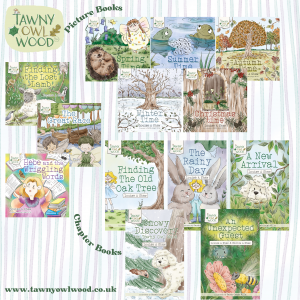
The Tawny Owl Wood series is thoughtfully split into two age ranges. The picture books, designed for pre-school through to early primary ages (up to around five or six years), use repetition as a key storytelling tool. This repetition helps children build confidence, familiarity, and a sense of achievement as they recognise words and phrases they have seen before.
The chapter books, aimed at children aged six and upwards, continue that sense of continuity. They use the same font style and maintain full-colour illustrations throughout — a feature often removed too early in children’s publishing.
“Keeping illustrations and consistent fonts helps children who find reading hard not only to read, but to stay engaged,” says Louise. “It reduces cognitive load and supports attention, which is especially important for neurodivergent readers.”
Hidden meanings and gentle themes are woven throughout the text, allowing the stories to grow with the child and be revisited again and again — a key principle of reading for pleasure highlighted in recent government discussions.
The development of the books has been shaped with professional care. Louise credits editor Lesley Hart of Author’s Pen with helping to bring the stories to life, and Sarah-Leigh Wills of Happydesigner for fully realising the vision through colour and illustration.
“We owe both Lesley and Sarah-Leigh so much,” Louise says. “From the very beginning, they understood the importance of preserving the vision while refining it — turning ideas into stories that genuinely support young readers.”
“Both myself and Sarah-Leigh are dyslexic, which gives us the upper hand when it comes to understanding how to make books appeal to children who struggle to read,” Louise continues. “We know first-hand the barriers that traditional books can create, and we design ours to remove those obstacles wherever possible.
“That said, Tawny Owl Wood is not just for neurodivergent children. Our books are created to be enjoyed by all readers. Inclusive design benefits everyone — whether a child struggles with reading, is learning to love books, or is already a confident reader. When stories are accessible, thoughtfully laid out, and visually engaging, every child wins.”
As national initiatives seek to rebuild a culture of reading, Tawny Owl Wood stands as a reminder that accessibility, representation and joy must sit at the heart of that mission.
“If we are truly to support the next generation to be the best they can be, children need to fall in love with reading,” Louise says. “Everything we do in life depends on the ability to read. Despite living in a digital age, the traditional skills of pen and paper still matter. Technology is incredible — but it shouldn’t replace books entirely. There has to be a happy medium.”
Government strategies may open the door — but it is thoughtful, child-centred storytelling that invites children to step inside.
If this really is a turning point for children’s literacy, it must include books that understand how children read — not just that they should.